Enter your child's age and wake-up time to get their perfect science-based bedtime — plus evening routine, nap schedule, and sleep regression guide.
🌙 Bedtime by age↔️ Works both directions🍼 Nap schedules😴 Sleep regression guide📊 Age-by-age sleep chart
Built by Rytell Tools using the American Academy of Sleep Medicine (AASM) pediatric sleep-duration guidelines and resources from the American Academy of Pediatrics. Informational only — not a substitute for your pediatrician. About this tool & our sources →
👶 Step 1 — Select your child's age
🍼Newborn0–3 mo
👶Baby4–11 mo
🧸Toddler1–2 yrs
🎨Preschool3–5 yrs
🎒School Age6–12 yrs
🎧Teen13–18 yrs
⏰ Step 2 — What do you know?
Recommended bedtime
—
—
Sleep target:—
📱 Share with your partner or caregiver — screenshot this result
🌙 Alternative bedtimes
Based on minimum, recommended, and maximum sleep for this age group.
🛁 Evening routine timeline
☀️ Nap schedule calculator
Select your child's age and morning wake-up time to get their ideal nap schedule for the day — including nap times, durations, and the latest bedtime to protect nighttime sleep.
🍼Newborn0–3 mo
👶Baby4–6 mo
👶Baby7–11 mo
🧸Toddler12–18 mo
🧸Toddler19 mo–3 yr
🎨Preschool3–5 yrs
☀️ Today's nap schedule
📈 Is my child in a sleep regression?
Enter your child's age to check whether they're in a known sleep regression period — and what to expect.
📅 All known sleep regression periods
The golden rule: Sleep regressions are temporary. The most important thing you can do is maintain your existing bedtime routine as consistently as possible. Introducing new sleep associations (nursing to sleep, rocking, co-sleeping) during a regression often creates habits that are harder to break than the regression itself.
📊 How much sleep does my child need by age?
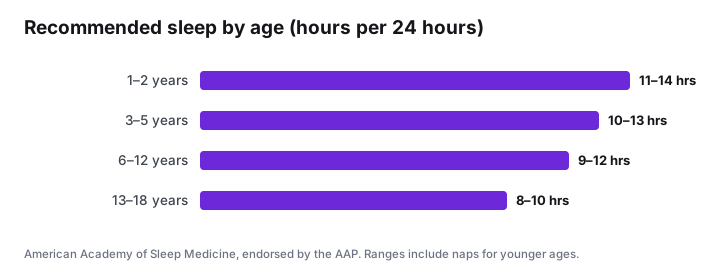
AASM-recommended sleep hours by age — from newborn through teen. Includes both nighttime sleep and daytime naps where applicable.
Age group
Total sleep
Naps
Typical bedtime
Source: Sleep recommendations are based on the American Academy of Sleep Medicine (AASM) 2016 consensus guidelines, which analyzed over 800 pediatric sleep studies. These are population-level recommendations — individual children's needs may vary by 30–60 minutes in either direction.
Sleep need falls with age in steps, not smoothly. Working backwards from wake-up time using the right band is what sets a realistic bedtime.
Bedtime by age — your questions answered
What time should my child go to bed?
🔬 Why sleep matters for children
🧠 Brain development
Deep sleep is when the brain consolidates memories and strengthens neural connections formed during the day. Children who get adequate sleep show measurably better learning, attention, and memory retention.
📏 Physical growth
Growth hormone is released primarily during deep sleep. Children who consistently under-sleep show measurable differences in height and weight gain compared to well-rested peers.
😊 Emotional regulation
Sleep deprivation in children manifests primarily as behavioral problems — tantrums, aggression, difficulty focusing, and hyperactivity (often misread as too much energy when it's actually too little sleep).
🛡️ Immune function
Cytokines — proteins that fight infection and inflammation — are produced primarily during sleep. Children who get adequate sleep get sick less often and recover faster when they do.